
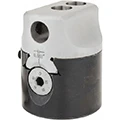
Boring heads and boring bar holders let machinists cut precise internal diameters that drills and reamers can't reach. A boring head mounts in a mill spindle and offsets a boring bar to an exact radius, while a boring bar holder clamps a boring bar rigidly on a lathe or CNC turning center. Penn Tool Co. stocks boring heads and accessories, boring bar holders and adapters, boring bar sleeves, reducing adapters, and holder accessories for manual and CNC machines.
Boring Heads & Bar Holders at a Glance
- Boring head: Mounts in a mill spindle and adjusts a boring bar off-center by a precise amount to cut an exact bore diameter.
- Boring bar holder: Clamps a boring bar on a lathe tool post, turret, or tool block, square and on center.
- Sleeves and reducing adapters: Let smaller-diameter boring bars fit larger holder bores, so one holder accepts many bar sizes.
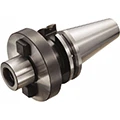
- Common boring head shanks: R8, Morse taper, CAT, BT, and straight shanks, often with interchangeable threaded shanks.
- Why boring: Boring corrects hole position and roundness and produces sizes and finishes that drilling alone can't.
What Is a Boring Head?
A boring head is a milling attachment that holds a boring bar in an adjustable slide. Turning a graduated dial moves the slide, offsetting the bar's cutting edge from the spindle centerline. As the spindle rotates, the cutting edge sweeps a circle, so increasing the offset enlarges the bore in small, controlled steps. Boring heads are the standard way to size bores on manual knee mills and are widely used on CNC machining centers for precision holes, counterbores, and large diameters.
On many boring heads, one dial graduation changes the bore diameter by .001", but some heads are graduated on radius instead, so check whether your dial reads on radius or diameter before making a cut.
Types of Boring Heads
- Offset (standard) boring heads: The most common type, with a graduated dial and multiple bar holes for small to large bores.
- Fine boring heads: Offer finer adjustment increments for tight-tolerance finishing on CNC machines.
- Rough boring heads: Often use twin cutters to remove more material quickly before finishing.
Shop boring heads and accessories, including shanks, boring bar sets, and wrenches.
Boring Bar Holders, Sleeves & Reducing Adapters
Boring bar holders grip boring bars on lathes, quick-change tool posts, and CNC turret tool blocks. Rigid clamping and correct center height are critical for good finish and chatter-free cuts.
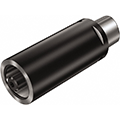
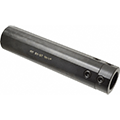
Boring bar sleeves slip into a holder bore and accept a smaller bar shank, while reducing adapters do the same in a more rigid, one-piece design. Split sleeves clamp evenly around the bar for better grip. These let one holder run a full range of bar sizes, reducing setup time and tooling inventory. Find clamp screws, wrenches, and other boring bar holder accessories here as well.
Boring Bar Overhang Guidelines
The farther a boring bar extends from its holder, the more it deflects and chatters. Overhang is expressed as a length-to-diameter (L/D) ratio. These are common rules of thumb; always follow the bar manufacturer's recommendations.
| Boring Bar Material | Typical Max Overhang (L/D) | Notes |
|---|---|---|
| Steel | About 4x bar diameter | Economical; best for short reach |
| Solid carbide | About 6x bar diameter | Roughly three times stiffer than steel |
| Vibration-damped (anti-vibration) | Beyond 6x, often 10x or more | For deep bores where chatter is a problem |
How to Choose Boring Heads & Bar Holders
- Match your machine: Choose a boring head shank that fits your spindle (R8, Morse taper, CAT, BT, or straight), or a bar holder that fits your tool post or turret.
- Check the bore range: Confirm the head's minimum and maximum boring diameters and the bar shank sizes it accepts.
- Use the largest, shortest bar that fits: A bigger diameter and shorter overhang give more rigidity and a better finish.
- Set center height: On lathes, set the cutting edge on the spindle centerline to avoid rubbing and poor finish.
- Use sleeves to standardize: Sleeves and reducing adapters let one holder accept many bar sizes.
- Consider coolant: Through-coolant holders and bars help evacuate chips from deep bores.
Looking for other tool holding? Browse the full tool holding category for collets, drill chucks, arbors, and lathe tool posts.
About Penn Tool Co.
Since 1968, Penn Tool Co., Inc. has supplied machinists, manufacturers, and government buyers with metalworking tools and precision instruments. The family-owned company is based in Maplewood, New Jersey, and holds GSA Contract GS-06F-0042S.
Penn Tool Co. offers a Price Match Guarantee and nationwide shipping. For help choosing a boring head or holder for your machine, call 800-526-4956 or request a quote.
Frequently Asked Questions
What is a boring head used for?
A boring head is used on a milling machine to bore holes to a precise diameter. It offsets a boring bar from the spindle centerline by an adjustable amount, so machinists can enlarge and size a hole in small, controlled increments.
How does a boring head work?
A boring head holds a boring bar in a sliding block. Turning the graduated dial moves the block off-center, and as the spindle rotates, the bar's cutting edge sweeps a larger circle. Each adjustment increases the bore diameter by a measured amount.
What is the difference between boring and reaming?
Boring uses a single-point tool that can be adjusted to any diameter and corrects a hole's position and straightness. Reaming uses a fixed-size multi-flute tool that follows the existing hole to improve size and finish but cannot correct location.
What is the difference between a boring head and a boring bar holder?
A boring head rotates with a mill spindle and offsets the boring bar to set the bore size. A boring bar holder is stationary, clamping the bar on a lathe or turning center while the workpiece rotates.
What is a boring bar sleeve used for?
A boring bar sleeve fits inside a boring bar holder and reduces its bore so it can hold a smaller-diameter boring bar. This lets one holder accept several bar sizes, saving setup time and the cost of extra holders.
How far can a boring bar stick out?
As a rule of thumb, steel boring bars work best up to about 4 times their diameter, solid carbide bars up to about 6 times, and vibration-damped bars well beyond that. Always check the manufacturer's recommendations for your specific bar.
How do I stop chatter when boring?
Reduce chatter by using the largest diameter and shortest overhang possible, switching to a carbide or damped bar for longer reach, setting the tool on center, using a sharp insert with a small nose radius, and adjusting speed and feed.
What shank do I need for a boring head?
Choose a shank that matches your machine spindle, such as R8 for Bridgeport-style knee mills, CAT40 or BT40 for many CNC machining centers, or a Morse taper. Many boring heads accept interchangeable threaded shanks.
Where can I buy boring heads and boring bar holders online?
Penn Tool Co. sells boring heads, boring bar holders, sleeves, reducing adapters, and accessories online with nationwide shipping. The Maplewood, NJ supplier has served machinists since 1968 and is a GSA contract holder.


