Calipers Explained: 3 Key Types for Precision B2B Use
Calipers Explained: 3 Key Types for Precision B2B Use

In the world of manufacturing, engineering, and quality control, success often boils down to a single, uncompromising standard: precision. A clearance of a tenth of a thousandth of an inch can be the difference between a high-performance part and a costly rework. What lies at the heart of maintaining this razor-sharp accuracy? It’s the caliper.
While all calipers are primarily concerned with measuring external, internal, depth, and step dimensions, the methods by which they deliver those measurements are significantly different. Needless to say, choosing the right one for your operation has a major bearing on efficiency, cost, and data management.
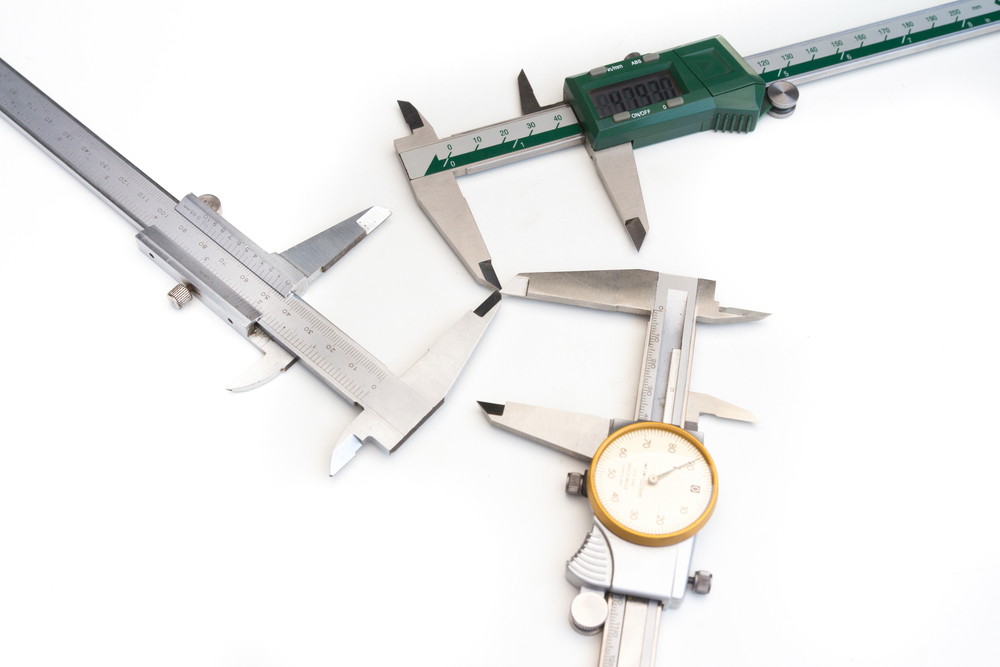
We’re going to break down the three fundamental types of calipers: Vernier caliper, dial caliper, and digital caliper, enabling you to make the right procurement decision for your facility.
1. The Foundation: The Enduring Vernier Caliper
The oldest of the three designs, the vernier caliper is rooted in centuries-old mechanical ingenuity. It’s the stalwart of the machine shop, a tool that requires no batteries and is built to withstand the harshest industrial environments.
How it Works: The Reading Challenge
The vernier caliper features a main scale and a sliding vernier scale. Reading it involves a two-part process:
- Reading the main scale to get the whole number and the first decimal place.
- Finding the line on the vernier scale that aligns perfectly with any line on the main scale. This aligned line provides the final, finer fractional measurement.
If you’re in the trade, you’d know that mastering the skill of how to read the vernier caliper is a rite of passage, requiring a sharp eye and training to avoid operator error.
Pros and Cons: A Trade-Off in Speed
|
Pros |
Cons |
|
Most Reliable: Works in wet, oily, or magnetic fields. |
Slowest to Read: Manual reading is time-consuming and prone to human error. |
|
Most Durable: Simple, all-mechanical construction. |
Lower Resolution: Typically 0.001" or 0.02mm, often requiring interpolation. |
|
Most Economical: Lowest initial purchase cost. |
Steeper Learning Curve: Requires trained operators for accuracy. |
In an era of lean manufacturing, the primary drawback of the vernier is its impact on inspection time. However, when it comes to specialized, large-component measurement, such as a Precise Heavy Duty Large Vernier Caliper 80”/2000MM, it remains an indispensable tool due to its rugged, reliable mechanism over long distances.
2. The Mid-Range Workhorse: The Dial Caliper
Often considered the workhorse in many American job shops, the dial caliper represents a significant evolutionary step toward user-friendliness while retaining the robustness of a purely mechanical tool.
How it Works: Simplifying the Readout
Instead of a secondary sliding scale, the dial caliper uses a miniature rack and pinion system. This mechanism drives a pointer around a circular dial, eliminating the interpolation required by the vernier scale.The user reads the whole inches and tenths of an inch from the main bar scale, and then reads the thousandths directly from the large dial indicator.
This immediate visual feedback makes it significantly easier to use. A standard dial caliper offers a resolution of $\mathbf{0.001}$" or $\mathbf{0.02}$mm, placing it on par with its modern counterparts in terms of raw resolution.
Dial vs. Digital Caliper: An Analog Preference
The dial vs digital caliper debate is often a matter of operator preference and environment.
|
Feature |
Dial Caliper |
Digital Caliper |
|
Readout |
Analog dial and main bar scale. |
Digital LCD display. |
|
Ease of Reading |
Good; faster than Vernier, less simple than Digital. |
Excellent; instant, error-free numerical display. |
|
Data Output |
None (unless equipped with specialized encoder). |
Excellent; often features SPC output for data collection. |
|
Environmental |
Highly durable; no batteries; resists coolant/dust better. |
Susceptible to moisture, coolant, and magnetic fields (though IP-rated models exist). |
For engineers and machinists who prefer tactile control and want a tool that is durable and non-reliant on batteries, the dial caliper is the perfect blend of precision and resilience.
3. The Modern Standard: The Versatile Digital Caliper
Thanks to the increasing need for speed, data collection, and integration with modern quality management systems, the digital caliper has emerged as the current market leader.
How it Works: The Instant Measurement
This type of caliper employs a linear encoder (a capacitance or magnetic system) to detect the position of the slide along the beam. The measurement is then processed and displayed instantly as a numeric value on a clear LCD screen.
The key features that make the digital caliper so popular for B2B applications are:
- Metric/Imperial Switching: An instantaneous button-press conversion between inches and millimeters.
- Zero-Setting: The ability to zero the tool at any point, allowing for quick calculation of comparative or "go/no-go" measurements.
- Data Output (SPC): Higher-end models feature Statistical Process Control (SPC) ports or wireless connectivity, allowing data to be logged directly to a computer for process analysis.
Vernier vs. Digital Caliper: Making the Right Choice
The decision between a traditional mechanical tool and a modern digital one should be driven by the environment and application.
- Choose Vernier or Dial Calipers when: Your environment is harsh (be it due to high coolant, oil, or magnetic interference), you prioritize long-term mechanical reliability over speed, or your budget demands the most economical solution.
- Choose Digital Calipers (the best digital caliper often being one with high IP-rating and SPC output) when: Your top priority is speed, you need instant switching between metric and imperial, or you require data logging and analysis for Statistical Process Control (SPC). The initial cost is higher, but the long-term saving in operator time and error reduction makes the ROI compelling.
For operations that demand the highest levels of contaminant protection, look for iP67 Coolant Proof models, which are specifically designed to withstand prolonged exposure to liquids, addressing the traditional vulnerability of electronics.
Final Thoughts: Bridging Accuracy and Efficiency
Selecting the ideal caliper—be it the robust Vernier, the resilient Dial, or the data-driven Digital—is a fundamental decision that impacts your entire quality control workflow. This choice is less about finding a universally "best" tool and more about aligning the tool's core strengths with your specific operational needs
At Penn Tool Co., we provide professional-grade measuring instruments from top brands, ensuring that whether you prioritize ruggedness or rapid data collection, you have the precision necessary to guarantee quality.