
How to Choose the Best Digital Caliper for Your Needs
How to Choose the Best Digital Caliper for Your Needs

Choosing the best digital caliper for your business can feel a bit like “splitting hairs” ~ precision matters, but so does reliability, usability, and fit for workflow. Whether you’re outfitting a shop floor or specifying tools as a purchasing manager, getting it right means efficiency, accuracy, and fewer headaches down the road. In this blog, we will explore how to confidently select the best digital caliper for your needs, with practical tips and insights on industry-leading models.
As a sophisticated instrument that acts as a vital data-capture and quality-assurance tool, a digital caliper is an investment in speed, repeatability, and data integrity. A well-matched caliper improves measurement certainty, operator confidence, and bottom-line productivity~ every time you close those jaws.
Why Digital Calipers Matter in Modern Industry
The humble caliper evolved phenomenally over the years, right from the traditional Vernier scale to the easily readable dial caliper. However, digital calipers have fundamentally changed the workflow, thanks to their crisp, clear LCD screen that eliminates the potential for human error inherent in reading fine Vernier or dial scales.
No wonder digital calipers are now considered the backbone of accurate measurement in machining, fabrication, quality control, and R&D environments. The precision of traditional vernier or dial calipers and the convenience of a high-resolution digital display~ they bring the best of both worlds. The result? Fast, repeatable metric or imperial readings, critical in high-tolerance manufacturing.
At Penn Tool Co., you can find an assortment of industry-grade digital calipers from leading brands. These calipers are typically accurate to ±0.001” (0.02 mm) and are well-suited to most part inspection, fixture setup, and fabrication checks.
Key Criteria for Selecting a Digital Caliper
- Accuracy and Resolution
Digital caliper accuracy impacts product quality and compliance. Look for digital calipers with an accuracy tolerance of at least ±0.02 mm (±0.001”) and resolution down to 0.01 mm (0.0005”) or better. High-precision models even hit 0.005 mm resolution for demanding applications.
- Build Quality and Materials
Industrial calipers should be crafted from hardened stainless steel for durability, feel, and long service life. Some models feature IP-rated resistance to dust and water, important for harsh or coolant-prone environments.
- Measurement Range and Types
The “standard” 6-inch (150 mm) model satisfies most needs, but extended 8”, 12” or even 24” models are available for large parts. Confirm that your tool can measure inside, outside, depth, and step dimensions for maximum versatility.
- Battery Life and Reliability
Efficient power draw, auto-on/off, and commonly available batteries (like SR44) are preferred. Look for models with multi-year battery life and “absolute scale” functionality, which retains zero even after power cycles.
- Display and User Interface
A clear, easy-to-read digital display reduces errors and speeds work. Features like unit conversion (inches/mm), data output (for SPC systems), and large buttons enhance usability for all operators.
- Brand Reputation and Support
Mitutoyo, SPI, iGaging, and Starrett are notable options, delivering a balance of consistent accuracy and after-sales service.
Leading Digital Calipers from Penn Tool Co.
Here are some standout calipers based on proven quality, performance, and availability from trusted brands:
|
Product (Penn Tool) |
Range |
Resolution |
Key Features |
Applications |
|
Mitutoyo Absolute Digimatic (500-196-30) |
0-6” |
0.0005” |
Absolute scale, auto power off, IP67 dust/water |
All-purpose, shop floor |
|
SPI Digital Caliper 0-6”/150mm |
0-6” |
0.0005” |
Stainless build, large LCD, inch/mm conversion |
Entry-level, backup |
|
iGaging OriginCal iP54 |
0-6” |
0.0005” |
iP54-rated, smooth slide, SPC output option |
Wet/coolant environments |
|
Mitutoyo Solar Caliper |
0-6” |
0.0005” |
Solar-powered, no battery needed |
Environmental, long-shift |
|
Starrett Electronic Calipers |
0-6” |
0.0005” |
Strong rep, workshop-proven reliability |
Inspection, high-volume |
These models represent industry benchmarks~ While Mitutoyo is universally lauded for reliability, an SPI caliper is the go-to choice for buyers prioritizing affordability in fleet purchases. iGaging, on the other hand, is the sought-after choice for smooth operation at mid-tier pricing.
Brand Comparisons: Mitutoyo vs. SPI vs. iGaging
|
Brand |
Key Strengths |
Typical Users |
|
Mitutoyo |
Longevity, precision, premium support |
Machinists, QC/QA Labs, OEMs |
|
SPI |
Solid value, good for basic needs |
Shops buying in bulk, trainees |
|
iGaging |
Smooth action, good accuracy for price |
Tech schools, mixed-use shops |
Caliper vs. Micrometer: Knowing When to Choose the Right Tool
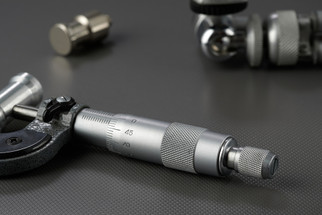
New technicians and purchasers are often confused about the appropriate use case for a caliper and a micrometer. The question of caliper vs. micrometer boils down to one factor: required precision.
|
Tool |
Typical Resolution |
Primary Function |
Best For |
|
Digital Caliper |
0.0005" / 0.01mm |
Measuring Inner, Outer, Step, and Depth |
Quick checks, measuring soft materials, or measuring components with tolerances greater than ±0.001". |
|
Micrometer |
0.0001" / 0.002mm |
Measuring Outer or Inner dimensions only |
High-precision work (e.g., bearing surfaces, gauge pins) with tolerances below ±0.001". |
Going by the thumb rule, digital calipers are your go-to versatility tool for 90% of shop floor and inspection needs, while micrometers are your dedicated instruments for critical, high-tolerance dimensions. Choosing a digital caliper for a job requiring 0.0001" accuracy is inviting failure. To put it in perspective, for most B2B manufacturing, calipers handle 95% of tasks; pull out a micrometer for final QC or when tolerances are especially tight.
Additionally, if you’re looking for other quality assurance tools for your operation, explore our full inventory and select the right dimensional measuring instruments.
The Final Verdict: Investing in Measurement Integrity
When making your purchase decision, focus on:
- Environment: Does your shop require IP67 protection (heavy coolant/dust) or will IP54 suffice?
- Data: Do you require SPC data output for quality records? Choose a model with this capability
- Reliability: Invest in ABS technology to guarantee your technicians never waste time re-zeroing and to eliminate origin-setting errors.
Final Thoughts: Making the Smart Choice
Selecting the best digital caliper is about matching feature set, durability, brand trust, and budget to your operational needs. A Mitutoyo digital caliper might be a smart pick for rugged, high-throughput environments, while SPI or iGaging digital caliper models offer exceptional value for training, back-up, or lighter-duty work.
Invest wisely; a well-matched caliper improves measurement certainty, operator confidence, and bottom-line productivity every time you close those jaws.