What Does a Micrometer Measure? A Beginner’s Guide to Precision Tools
What Does a Micrometer Measure? A Beginner’s Guide to Precision Tools

"Close enough" in North American manufacturing can cost a company thousands of dollars in scrapped parts, stalled production lines, and lost contracts. Let us put it this way: when you are dealing with tolerances where a human hair is considered "thick," you need more than just a steady eye; you need a micrometer.
Whether you are a shop manager looking to upgrade your quality control lab, a purchasing agent sourcing reliable equipment for a fleet of machinists, or a newcomer to the trade, understanding the nuances of micrometer measurement is the first step. This guide explores what a micrometer measures, why it remains the gold standard for precision, and how to choose the right one for your workflow.
The Heart of Precision: What Does a Micrometer Measure?
At its simplest, a micrometer (often called a "mike") is a precision instrument designed to measure the physical dimensions of an object, such as its thickness, diameter, or depth, with incredible accuracy. To put it plainly, it measures the integrity of your manufacturing process.
Most standard micrometers in a North American machine shop measure in increments of 0.001 inches (one-thousandth) or 0.0001 inches (one-ten-thousandth, often referred to as "a tenth" by machinists).
Some of the common micrometer tool uses include:
- Thickness: Measuring the gauge of sheet metal or the walls of a machined part.
- Outside Diameter (OD): Checking the precision of shafts, pins, and spheres.
- Inside Diameter (ID): Measuring the width of bores, tubes, and holes.
- Depth: Determining the exact depth of slots or blind holes.
Micrometer vs. Caliper: Understanding the Difference
In any B2B procurement discussion, the question eventually arises: "Do we really need micrometers if we already have high-quality digital calipers?" The answer is almost always yes. While they overlap in function, they differ in application and "Abbe’s Principle": a geometric rule stating that for maximum accuracy, the scale and the measurement axes must be collinear.
|
Feature |
Digital Caliper |
Micrometer |
|
Typical Accuracy |
±0.001" (0.02mm) |
±0.0001" (0.002mm) |
|
Versatility |
High (4-way measurement) |
Low (Task-specific) |
|
Speed |
Fast for quick checks |
Slower, deliberate measurement |
|
Primary Use |
General fabrication / Layout |
Final inspection / High-tolerance machining |
A caliper’s jaws can flex slightly under pressure, leading to "operator feel" errors. A micrometer, however, uses a calibrated screw thread and a ratchet stop to ensure consistent pressure every single time. Thanks to this repeatability, precision measuring tools like the micrometer are non-negotiable for ISO-certified facilities.
The Anatomy of a Machinist’s Micrometer
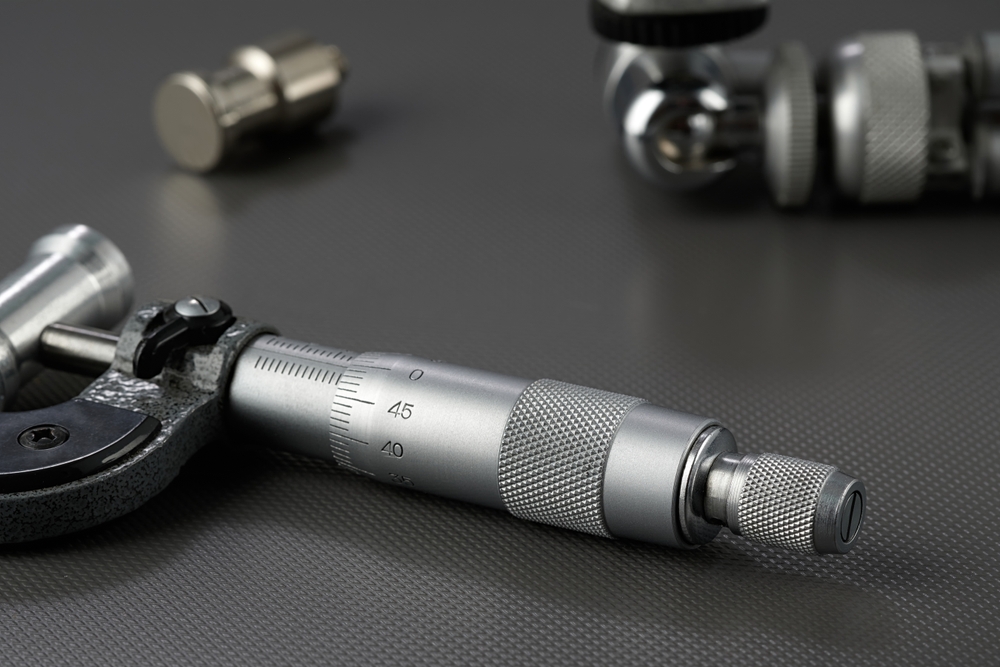
To understand how to use a micrometer, one needs to look closely at the components that make it work. A classic outside micrometer measurement involves several key parts:
- The Frame: The U-shaped body that holds the anvil and barrel. A heavy, rigid frame prevents thermal expansion from affecting the reading.
- The Anvil: The stationary measuring face that the part rests against.
- The Spindle: The moving measuring face that advances toward the anvil.
- The Sleeve (or Barrel): The stationary scale that shows the "large" increments (0.1" and 0.025").
- The Thimble: The rotating part that the operator turns, showing the "fine" increments (0.001").
- The Ratchet Stop: A mechanism at the end of the thimble that "clicks" when the correct amount of pressure is applied. This is the secret to accuracy.
Types of Micrometers: Choosing the Right Tool for the Job
Not all parts are shaped the same, which is why there are several specialized types of micrometers available at industrial suppliers like Penn Tool Co..
The most common variety, used for measuring wires, spheres, shafts, and blocks. If someone says, "Hand me a micrometer," this is usually what they mean.
These come in two forms: caliper-type (with small jaws) and rod-type. They are used to measure the internal diameter of cylinders or the distance between two parallel surfaces.
Equipped with a flat base and interchangeable rods, these measure the depth of holes, slots, or recessed surfaces with much higher precision than the depth rod on a caliper.
-
Blade Micrometers: For measuring narrow grooves (like O-ring seats).
-
Disc Micrometers: For measuring "paper-thin" materials or gear teeth.
-
Point/Spline Micrometers: For reaching into small recesses or measuring wall thickness of curved tubing.
Machinist Micrometer Guide: How to Get a Perfect Reading
Learning how to use a micrometer is a rite of passage. Follow these steps to ensure your micrometer measurement is "spec-perfect":
-
Clean the Faces: Even a speck of dust or a film of oil can throw a reading off by 0.0005". Wipe the anvil and spindle with a lint-free cloth.
-
Zero the Tool: Close the micrometer completely (or use a standard/gauge block for larger sizes). The "0" on the thimble should align perfectly with the index line on the sleeve.
-
Position the Workpiece: Place the part against the anvil. Ensure it is square and centered.
-
Rotate the Thimble: Turn the thimble until the spindle is close to the part.
-
Use the Ratchet: Switch to the ratchet stop or friction thimble. Turn it until it clicks three times. This ensures the pressure is identical every time you measure.
-
Lock and Read: Use the locking nut to hold the spindle in place before reading the scale (or viewing the digital display).
Pro-Tip for Shop Managers: Always remind operators to hold the micrometer by the insulated frame grip. Heat from a human hand can cause the metal frame to expand, leading to inaccurate readings in high-precision environments.
Why B2B Buyers Trust Penn Tool Co. for Precision
In a high-stakes production environment, the "cost" of a tool isn't just the price on the invoice; it’s the cost of the tool failing mid-shift. Purchasing managers look for brands that offer longevity, recalibration support, and documented accuracy.
At Penn Tool Co., we stock the industry’s most trusted names, including:
-
Mitutoyo: The global leader in digital and mechanical precision.
-
Starrett: An American legend known for ruggedness and classic "machinist feel."
-
Brown & Sharpe: High-end Swiss-engineered precision.
-
iGaging & SPI: Excellent "shop floor" options that balance cost and performance.
Investing in high-quality precision measuring tools means fewer QC disputes, higher throughput, and the confidence that when your customer checks your work, the numbers will match. By choosing the right types of micrometers and training your team on proper micrometer tool uses, you are investing in the long-term quality of your brand.
Frequently Asked Questions
1. What is the difference between a 0-1" and a 1-2" micrometer?
Micrometers have a limited travel range, usually 1 inch. A 0-1" micrometer measures anything from zero to one inch. A 1-2" micrometer starts its measurement at 1.000", requiring a "standard" (a precision block) to zero it out before use.
2. Why should I use a ratchet stop instead of just tightening the thimble?
The ratchet stop is a clutch mechanism. If you tighten the thimble by hand, you may apply too much force, slightly compressing the part or flexing the tool's frame. The ratchet ensures a consistent, repeatable "feel" regardless of who is using the tool.
3. How do I maintain my micrometer measuring tool?
Keep it in its protective case when not in use. Apply a light coat of high-quality instrument oil to prevent rust, and never store it with the anvil and spindle touching—this can lead to "wringing" or corrosion between the faces.