How to Build a Safe and Efficient Compressed Air System
How to Build a Safe and Efficient Compressed Air System

The Breath of the Shop: A Strategic Guide to Compressed Air System Design
In the high-stakes theater of modern manufacturing, where heavy machinery hums with the force of thousands of pounds of pressure, there is a silent language being spoken. It isn't a language of code or digital interfaces, but one of flow, pressure, and containment. It is the language of your compressed air system.
Picture a bustling facility in the American Midwest. A high-end CNC center is mid-cycle, a robotic arm is shifting components with surgical precision, and a pneumatic sander is putting the final finish on an aerospace grade part. Everything seems perfect. But behind the walls, a silent battle is being waged. A kinked hose here, a leaky coupling there, and an improperly sized regulator elsewhere are creating a "pressure drop" that is slowly starving your machines. The result? Inconsistent performance, increased energy costs, and that dreaded, high-pitched hiss that signals money literally leaking out of your facility.
Many shop owners view compressed air as a utility something that should just "be there" when they open a valve. But for the premium manufacturer, air is a primary process medium. Treating it as a mere utility is a mistake that costs thousands in electricity and maintenance annually.
At Penn Tool Co., we believe that compressed air system design is one of the most critical aspects of shop efficiency. Today, we’re going to walk you through how to build a system that is as safe as it is efficient, ensuring that the "breath of your shop" remains clean, steady, and ready for work.
1. The Foundation: Sizing and The "Hidden" Costs
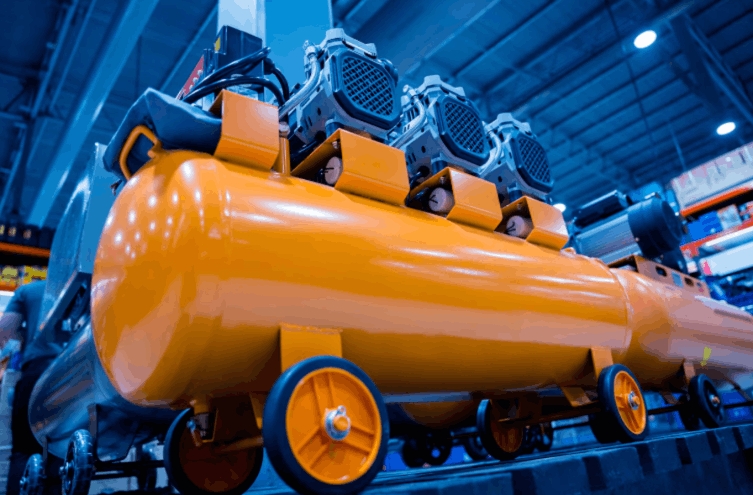
Before you install a single pipe or plug in an air compressor, you must define your load. The most common mistake in system design is the "undersized/overworked" trap. Many shops start with a small, portable compressor, and as they add machines, they daisy-chain more small compressors together.
This is the path to inefficiency.
A properly designed system should be built around your peak demand, not your average demand. If your system is undersized, your compressor will cycle excessively, leading to premature wear and massive energy spikes.
The Golden Rule: Design for the future, not just today. If you plan on adding another machining center in the next two years, size your piping and compressor capacity to accommodate that growth now. Investing in a slightly larger, more efficient compressor today is significantly cheaper than ripping out your entire piping infrastructure tomorrow.
2. The Arteries: Piping and Distribution
If the compressor is the heart, the piping is the circulatory system. In too many shops, the piping layout looks like a plate of spaghetti a chaotic maze of mismatched hoses and T-fittings.
Shop air should be distributed through a logical, looped system. A "closed-loop" piping design allows air to reach every outlet from two directions, which minimizes pressure drops and ensures consistent pressure across the entire floor.
Key considerations for your "arteries":
- Material Matters: Avoid iron pipe if possible; over time, it rusts, and that rust will inevitably end up in your delicate CNC valves or pneumatic tools. Aluminum piping systems are the new gold standard for premium shops. They are lightweight, modular, and provide a perfectly smooth interior surface that prevents pressure-robbing turbulence.
- The Slope: Always install your main headers with a slight downward slope, and install "drops" with drains at the lowest points. Water is the natural enemy of compressed air. Even with a good dryer, some moisture will condense. You want that water to pool in a drain, not travel into your expensive impact wrench.
3. The Quality Control: Filters and Regulators
Compressed air, straight from the pump, is "dirty." It contains oil, water, and microscopic metallic dust. If you run this raw air into your equipment, you are inviting failure. This is where your filters and regulators become the true heroes of your shop.
The Filter Triad:
- Primary Filter: Removes larger debris and bulk water.
- Coalescing Filter: The most important stage. It removes fine oil aerosols and microscopic moisture droplets. If you are doing any kind of painting or high-precision pneumatic control, this filter is non-negotiable.
- Desiccant Dryer: For premium shops, a dryer is the ultimate insurance policy. It pulls the humidity out of the air before it ever enters your piping, preventing rust and freezing in cold climates.
The Regulator: Think of the regulator as the "governor" of your tool. Never run a tool at higher pressure than the manufacturer recommends. If a tool is rated for 90 PSI, running it at 110 PSI doesn't make it "stronger" it makes it wear out twice as fast while wasting electricity. Install individual regulators at every major workstation to give your operators fine-tuned control over their output.
4. The Interface: Choosing the Right Air Hoses
We often spend thousands on the compressor and the piping, only to cheapen out on the air hoses. But the hose is the final point of connection. A heavy, stiff, rubber hose is not only exhausting for an operator to drag around all day, but it also creates drag and kinking that restricts airflow.
Look for high-quality polyurethane or hybrid polymer hoses. They are lightweight, kink-resistant, and remain flexible even in colder shop temperatures. Remember: air hoses are a wear item. Don’t wait until you see the reinforcement braid poking through the outer jacket to replace them. A hose failure under pressure is a safety hazard; a proactive replacement program is a sign of a professional shop.
5. Safety and Maintenance: The Human Element
Safety in a compressed air system isn't just about wearing safety glasses (though you should). It’s about managing stored energy.
-
Lockout/Tagout (LOTO): Every air drop should have an isolation valve. When working on a machine, your technicians must be able to close that valve and lock it, ensuring that no stray air pressure can actuate a cylinder while their hands are in the machine.
-
The "Hiss" Hunt: Conduct a monthly "leak hunt." Take a walk through your shop during lunch or on a quiet Saturday. If you can hear a hiss, you are paying for that air at 100% of your electrical rate. A single 1/8-inch leak in your air lines can cost you hundreds of dollars in electricity per year.
6. The Procurement Strategy
When shopping for your system at Penn Tool Co., look for components that are "industrial-grade." Avoid the big-box store plastic fittings. When you are dealing with 100+ PSI of force, the fitting is the last thing you want to fail.
Always look for:
-
High-Flow Fittings: These allow more air to pass through with less pressure drop.
-
Modular Systems: Systems that allow you to add filters, regulators, and lubricators (FRLs) in a tidy, stacked configuration.
-
Vibration Dampening: Ensure your compressor is mounted on anti-vibration pads. The vibration that travels through the floor is just as damaging to your building as it is to your expensive machines.
Final Thoughts
Your compressed air system is the unseen backbone of your facility. It deserves the same level of engineering scrutiny as your CNC machines, your CAD software, and your quality control process. By designing a system that focuses on clean, dry, and consistently delivered air, you aren't just saving money on energy, you are extending the life of your equipment and creating a safer, more professional environment for your team.
Precision is a habit. It starts with the air you use to build your products.
Frequently Asked Questions (FAQ)
1. Why does my shop air have water in it, even if I have a filter?
Standard filters are designed to catch bulk water and debris, but they cannot remove water vapor. As air cools in your pipes, that vapor condenses into liquid water. To solve this, you need a refrigerated or desiccant dryer in your compressed air system design to remove moisture before it enters the distribution lines.
2. What is the biggest "hidden" cost in compressed air?
Leaks. Most shops have air leaks totaling 20% to 30% of their total compressor capacity. Because compressed air is one of the most expensive forms of energy in a factoryconverting electricity into potential energy is inefficientleaks represent a direct, unnecessary hit to your operational budget.
3. Are there specific pressure requirements for pneumatic tools?
Most pneumatic tools are optimized for 90 PSI at the tool inlet. Using regulators to maintain exactly 90 PSI ensures the tool performs at its peak torque and speed. Operating above 90 PSI increases tool wear and energy waste, while operating below 90 PSI leads to sluggish tool performance and lower productivity.
4. How often should I drain my air tank?
If you do not have an automatic condensate drain, you should drain your air compressor tank daily. Even a small amount of accumulated water can lead to internal tank corrosion, which is a major safety hazard. Modern automatic drains are an inexpensive way to automate this critical safety step.
5. What is the difference between a filter, a regulator, and a lubricator (FRL)?
An FRL is the "total package" for your air preparation. The filter cleans the air, the regulator sets the pressure, and the lubricator adds a fine mist of oil (only for air tools that require it). Modern CNCs and robotics usually require clean, dry, oil-free air, so be sure to choose an FRL configuration that matches your specific machine’s needs.