
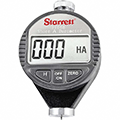
Hardness Testers & Rockwell Hardness Testers
Hardness testing helps manufacturers verify that a material or finished part meets the requirements of the job. Penn Tool Co. carries hardness testers for production, inspection, and quality control, including a wide selection of Rockwell hardness testers and durometers.
Choosing the right tester starts with the material and required hardness scale. Browse Penn Tool's inspection and testing instruments for related equipment, or compare the hardness testing methods and options below to find the right fit for your application.
What Does a Hardness Tester Measure?
Material hardness describes resistance to permanent indentation. A hardness tester measures this property using a defined testing method and reports the result on the corresponding hardness scale.
For manufacturers and metalworking operations, hardness testing can help:
- Verify materials
- Heat-treated part inspection
- Support production
- Create quality control
Because different materials and applications call for different testing methods, the required scale is an important starting point when selecting equipment.
Why Reliable Hardness Testing Matters
A hardness tester gives a shop or quality department a repeatable method for checking a material characteristic against the appropriate scale or specification. This can support incoming inspection, production checks, material comparison, and verification after processes such as heat treatment. Reliable results still depend on using the correct test method and following the requirements.
Rockwell Hardness Testers for Metal Testing
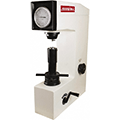
A Rockwell hardness tester measures the hardness of metals based on how deeply an indenter penetrates the material under a controlled force. The Rockwell scale used for the test determines the indenter and force required for an accurate measurement.
Penn Tool carries several Rockwell configurations. Examples include the:
- Phase II Rockwell Hardness Tester 900-331
- Mitutoyo HR Series Rockwell Hardness Tester HR-320MS
- Mitutoyo HR Series HR-430MS.
Penn Tool's Rockwell selection includes models from Mitutoyo, along with options for regular and superficial Rockwell testing, such as the SPI Dial Rockwell Scale Hardness Tester.
What Is Superficial Rockwell Hardness Testing?
Superficial Rockwell testing uses the same general depth-measurement principle as regular Rockwell testing but uses lower test forces. It is used when the indentation produced by regular Rockwell testing would be too large or deep for the specimen or testing requirements.
Not every Rockwell hardness tester supports superficial testing, so the tester's supported scales and test forces should be confirmed when selecting equipment.
Hardness Tester Types Available at Penn Tool Co.
The category includes several testing technologies and instrument formats. Choosing among them starts with the material, required hardness scale, geometry, and testing procedure.
| Hardness Tester Type | How It Is Used | Penn Tool Example |
| Bench-top Rockwell tester | Stationary hardness testing where the specimen can be positioned in the machine | Mitutoyo HR-430MS |
| Portable Rockwell tester | Rockwell testing when bringing the tester to the workpiece is more practical | Ames Standard Portable Rockwell Tester Model 1 |
| Rockwell/superficial Rockwell tester | Supports regular and superficial Rockwell testing | SPI 21-315-7 |
| Portable electronic hardness tester | Electronic portable testing; supported scale and method depend on the instrument | SPI Shore A Portable Electronic Hardness Tester |
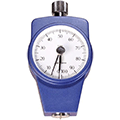
| Dial durometer | Measures indentation hardness in materials such as rubber and plastics using Shore A, Shore D, or another applicable Shore scale | Mitutoyo Hardmatic HH-300 Shore A |
| Digital durometer | Electronic durometer testing on its specified Shore scale | Phase II Digital Durometer PHT-960 |
| Barcol hardness impressor | Indentation hardness testing for materials such as softer metals, plastics, and composites using the Barcol scale | DeFelsko PosiTector BHI |
These instruments should not be treated as interchangeable. The appropriate hardness tester is determined by the test method required for the material and inspection procedure.
Portable Hardness Testers
A portable hardness tester allows testing to be performed away from a dedicated bench setup. This can be useful when a component is difficult to move or hardness measurements need to be taken closer to the production or inspection area.
Penn Tool separates its portable selection into dial hardness testers and electronic models. The actual test method, hardness scale, material compatibility, specimen requirements, and orientation limitations vary by instrument. So, the term "portable" describes the format rather than one universal hardness testing method.
Portable Rockwell Hardness Testers
Portable Rockwell equipment provides another option when conventional bench-top testing is impractical for the workpiece. Penn Tool carries the Ames Standard Portable Rockwell Tester Model 1 as part of its current hardness testing selection.
The correct portable Rockwell tester still needs to match the required Rockwell scale and specimen. Part size, geometry, test location, and instrument specifications all matter when choosing equipment.
Rockwell vs. Brinell vs. Shore Hardness Testing
Different hardness tests generate values using various procedures, so results should always be identified by their test method and scale.
| Method | Measurement Principle | Common Material Category |
| Rockwell | Measures penetration depth under prescribed test forces | Primarily metallic materials |
| Brinell | Measures the diameter of an indentation produced by a ball indenter | Metallic materials |
| Shore durometer | Measures indentation depth using a spring-loaded indenter | Elastomers, rubbers, and certain plastics |
Rockwell and Brinell are different hardness testing methods, each with its own testing process and hardness scale. The right method depends on the material and testing requirements.
Diving Deeper: A Comparison of Hardness Testers and Durometers
A durometer is a type of hardness tester, but the term typically refers to instruments that measure indentation hardness using a Shore scale. Shore durometers are commonly used for rubber, elastomers, and certain plastics, while methods such as Rockwell are primarily used for metallic materials.
Penn Tool carries both types of equipment. Its current selection includes Rockwell hardness testers for metal testing as well as Shore A and Shore D durometers in dial and digital configurations.
| Feature | Rockwell Hardness Tester | Shore Durometer |
| Common use | Metallic materials | Rubber, elastomers, and certain plastics |
| Measurement | Penetration depth under specified test forces | Indentation depth under a specified Shore method |
| Result | Rockwell scale value, such as HRC or HRB | Shore scale value, such as Shore A or Shore D |
| Penn Tool examples | Mitutoyo, Phase II, SPI, Ames | Mitutoyo, Phase II, Flexbar, Precise |
Penn Tool's durometer selection includes the Phase II Digital Durometer PHT-960, Shore A, Flexbar Digital Shore A Durometer, Flexbar Digital Shore D Durometer, and Precise Shore A & D Scale Dial Durometer Set.
The required Shore scale depends on the material and testing procedure. Shore A and Shore D instruments should not be treated as the same device simply because both are durometers.
Selecting the Right Hardness Tester
Start with the required test method rather than choosing an instrument based only on portability or display type.
Material and Required Hardness Scale
Confirm which test method and hardness scale apply to the material and inspection requirement. A Rockwell hardness tester intended for metallic materials serves a different purpose than a Shore durometer used on elastomers or plastics.
Specimen Size and Geometry
The tester must physically accommodate and properly support the specimen. Throat dimensions, anvils, test surface, part shape, and access to the intended test location can all affect equipment selection.
Penn Tool carries related hardness tester accessories, including anvils and penetrators for specific equipment and applications.
Bench-Top or Portable Testing
A bench-top tester can be practical for dedicated inspection areas where specimens are brought to the machine. Portable equipment can make more sense when the component itself is difficult to move, or testing needs to occur elsewhere in the facility.
Analog or Digital Readout
Penn Tool carries both analog and digital hardness testing equipment. Display type can affect how readings are viewed and recorded, but it does not determine the underlying test method.
Calibration and Verification Requirements
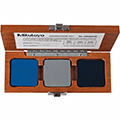
Hardness testing depends on the tester and test setup being suitable for the required procedure. Penn Tool Co. offers hardness calibration test blocks for checking hardness testing equipment against known reference values.
Always select blocks, indenters, and other accessories that are compatible with the tester or hardness scale.
Hardness Testing in Industrial Inspection
Hardness testing is used across manufacturing and inspection environments because it provides a standardized material measurement without requiring the type of full-scale mechanical testing.
Applications can include material verification, production inspection, heat-treatment checks, and quality control. Hardness testing is used in industries such as:
- Aerospace
- Automotive
- Metalworking
- Construction
- Energy
- Oil and gas
- Pipeline
- General manufacturing
For a broader look at the instruments used to check manufactured parts and materials, explore Penn Tool Co.'s precision measuring tools.
Hardness Tester Brands and Equipment at Penn Tool Co.
Penn Tool Co. has supplied industrial tooling and equipment for nearly six decades. Our hardness testing catalog includes products and accessories from manufacturers such as Mitutoyo, Phase II, SPI Swiss Precision Instruments, and many more.
Discover the Right Hardness Tester at Penn Tool Co.
Selecting a hardness tester starts with knowing the material, required test method and scale, dimensions, and where the test will be performed. Penn Tool So. provides bench-top and portable equipment for a range of industrial hardness testing requirements, including Rockwell hardness testers and Shore durometers.
Browse the hardness testers above or contact Penn Tool Co. for help narrowing the selection to equipment that fits your testing requirements.
Frequently Asked Questions About Hardness Testers
What is a hardness tester?
A hardness tester measures how resistant a material is to permanent indentation. The right tester depends on the testing method, including factors such as:
- The material being tested
- The required hardness scale
- The indenter and test force
- The testing procedure
What is a Rockwell hardness tester?
A Rockwell hardness tester measures hardness based on the depth of penetration produced under specified test forces. Rockwell includes multiple scales that use prescribed combinations of indenters and forces, making scale selection an important part of the test.
How does a Rockwell hardness tester work?
A Rockwell test applies a preliminary force followed by an additional test force according to the specified Rockwell procedure. The hardness value is determined from the permanent increase in penetration depth after the additional force is removed while the preliminary force remains applied.
What is the difference between Rockwell and Brinell hardness testing?
The two methods determine hardness differently:
- Rockwell: Uses penetration depth to determine the hardness value.
- Brinell: Uses the measured diameter of an indentation produced by a ball indenter.
The correct method depends on the material, specimen, and testing requirements.
What is a portable hardness tester?
A portable hardness tester is designed so testing can be performed away from a permanent bench setup. Penn Tool Co. offers portable dial and electronic hardness testers as well as portable Rockwell equipment.
Is a durometer a hardness tester?
Yes. A durometer is a type of hardness tester generally used to measure indentation hardness on Shore scales for materials such as rubber, elastomers, and certain plastics. Shore A and Shore D are different scales and require equipment suited to the applicable material and testing procedure.
What should I consider before buying a Rockwell hardness tester?
Start by confirming:
- The Rockwell scale or scales required
- The specimen's material, dimensions, and geometry
- Regular or superficial Rockwell requirements
- Bench-top or portable testing needs
- Compatible anvils, indenters, and calibration blocks
The specifications of the individual tester should then be checked against the required test procedure.
Does Penn Tool Co. sell hardness tester calibration blocks and accessories?
Yes. Penn Tool carries hardness calibration test blocks as well as hardness tester accessories. Our current listings feature:
- Anvils
- Penetrators
- Test block kits
- Stands
- Other components
Compatibility should be confirmed for the specific tester and hardness scale before ordering.


