Precision Measuring Tools for Accurate, Repeatable Results
Precision measuring tools are an invaluable resource for any professional. They allow you to make informed decisions by providing you with precise measurements.
The dimensions you need, and the manner in which you collect the data, will depend on the projects you're conducting. It's often beneficial to have a range of precision measuring tools at your disposal.
For over five decades, Penn Tool Co. has helped professionals find the right precision measuring tools for the job, bringing decades of expertise since 1968.
Precision Measuring Instruments and Equipment
Since the beginning, Penn Tool Co. has focused on curating the most precise measuring instruments from a wide variety of manufacturers.
What Are Precision Measuring Tools?
Precision measuring tools are instruments designed to capture dimensional, weight, moisture, or other physical measurements. These measurements are captured with a high degree of accuracy and repeatability. Depending on the application, these tools may measure:
1. Length
2. Thickness
3. Weight
4. Flatness
5. Moisture content
6. Magnetic flux density
…among other properties. Additionally, precision measuring tools are relied on for:
1. Accurate, repeatable measurements
2. Quality control and inspection
3. Machine setup and calibration
4. Compliance with production specifications
5. Consistent results across repeated use
6. Support for a wide range of trades and industries
Digital vs. Mechanical Precision Measuring Tools
Precision measuring tools are generally available in digital and mechanical formats. Each offers distinct advantages depending on the application.
|
Feature
|
Digital Tools
|
Mechanical Tools
|
|
Readout
|
Direct numerical display
|
Requires reading a scale, dial, or vernier
|
|
Data Transfer
|
Often able to transfer data to a computer
|
Typically requires manual recording
|
|
Power Source
|
Requires batteries or power
|
No power source required
|
|
Ease of Use
|
Generally faster and easier to read
|
Requires more skill to read accurately
|
|
Durability
|
Varies by model; some require careful handling in harsh environments
|
Often well-suited to rugged or harsh working environments
|
The best measuring devices record data with exceptional accuracy, are electronic, and can transfer data to a computer with ease, though mechanical and analog tools remain valuable for their reliability in the field.
Types of Precision Measuring Tools
With these tools in hand, it's possible to maximize efficiency and productivity in a wide range of industries and applications. Measure the dimensions of everything, from millimeter-wide strips of leather to the magnetic flux density in magnetism applied products.
1. Balances & Scales Our balances and scales allow you to determine the weights of machine-milled parts, shipping boxes, and more.
2. Calculators We have industrial calculators that are specifically designed for certain tasks, such as construction and electrical code compliance, and material cost estimation.
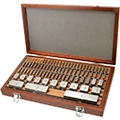
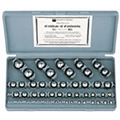
3. Calibration, Layout & Machine Setup Tools From separators to parallels, we have everything you need to calibrate and set up your machines.
4. Laser Levels When you need to keep things on the same plane, our laser levels are offered for a diverse assortment of applications.
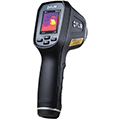
5. Moisture Meters To measure moisture, humidity, and temperature, opt for one of our many reliable moisture meters.
6. Specialty Micrometers Our specialty micrometers are perfect for accurately gauging the thickness of a variety of metal parts.
7. Specialty Test Equipment In addition to Gauss meters, we also carry a large selection of specialty test equipment, from telescopic probe extenders to roughness tester profilometers.
Precision Measuring Tool Brands We Carry
Penn Tool Co. carries precision measuring tools from established manufacturers trusted by machinists, toolmakers, and quality control professionals.
1. Mitutoyo is a globally recognized manufacturer of precision measuring instruments, offering calipers, micrometers, height gauges, and other metrology tools trusted across manufacturing and quality control applications.
2. SPI Swiss Precision Instruments offers a wide range of precision measuring tools, including calipers, micrometers, and gauges, used across machine shops and industrial applications.
3. Starrett has manufactured precision measuring tools since 1880, offering calipers, micrometers, gauges, and other instruments trusted by machinists and toolmakers for generations.
4. Insize manufactures a broad catalog of precision measuring instruments, including calipers, micrometers, and gauges, used across manufacturing, machining, and quality control applications.
5. Precise offers precision measuring tools, including calipers and micrometers, designed for reliable, everyday use in machine shops and industrial settings.
These brand partnerships ensure you have access to reliable, high-performance precision measuring tools for any application.
Overview of Different Precision Measuring Tools
Each precision measuring tool has a specific function, depending on the application and need.
|
Tool Category
|
What It's Used For
|
|
Balances & Scales
|
Determining the weight of parts, materials, and shipping items
|
|
Calculators
|
Task-specific calculations for construction, real estate, electrical code compliance, and material cost estimation
|
|
Calibration, Layout & Machine Setup Tools
|
Calibrating and setting up machines for accurate production
|
|
Laser Levels
|
Keeping surfaces and installations aligned on the same plane
|
|
Moisture Meters
|
Measuring moisture, humidity, and temperature
|
|
Specialty Micrometers
|
Gauging the thickness of metal parts with precision
|
|
Specialty Test Equipment
|
Specialized diagnostics, from magnetic flux density to surface roughness
|
Key Factors to Consider for Selecting the Right Precision Measuring Tools
Selecting the right precision measuring tool involves more than picking a category, accuracy requirements, and durability all play a role. Consider the following:
1. Required Accuracy: Applications involving tight tolerances or strict quality standards may call for higher-precision instruments.
2. Application Type: Match the tool to the task, whether it's dimensional inspection, machine setup, weighing, or moisture testing.
3. Digital vs. Mechanical: Decide whether direct digital readout and data transfer, or a rugged mechanical design, better suits your working environment.
4. Working Environment: Consider durability, temperature range, and exposure to dust, moisture, or vibration.
5. Calibration Needs: Factor in how often the tool will need to be calibrated to maintain accuracy over time.
Built for Precision Across Trades and Industries
From production floors to job sites, precision measuring tools help professionals achieve accurate, dependable results.
Common applications include:
1. Machining and die making
2. Quality control and inspection
3. Construction and real estate
4. Electrical code compliance
5. Manufacturing and machine shop production
6. Material cost estimation
7. Magnetism and material testing applications
The Best Measuring Instruments Suppliers
At Penn Tool Co, we strive to provide you with a wide selection of top-quality, superior-performing precision measuring tools.
We carry all the precision measuring instruments you'll need to help you complete your task. Further, to ensure quality and durability, we carry only the most reliable brands. If you want to know more about the best measuring instruments on the market, reach out to our team today.
Frequently Asked Questions About Precision Measuring Tools
What are precision measuring tools?
Precision measuring tools are instruments designed to capture accurate, repeatable measurements of dimensions, weight, moisture, or other physical properties for use in trades, manufacturing, and quality control.
What is the difference between digital and mechanical precision measuring tools?
Digital precision measuring tools provide a direct numerical readout and often allow data to be transferred to a computer, while mechanical or analog tools rely on a scale, dial, or vernier reading and don't require a power source.
What industries use precision measuring tools?
Precision measuring tools are used across machining, die making, manufacturing, construction, quality control, electrical compliance, and material testing applications, among others.
How do I choose the right precision measuring tool?
Consider the required accuracy, the specific application, whether a digital or mechanical design better suits your environment, and how durable the tool needs to be for your working conditions.
Why is calibration important for precision measuring tools?
Regular calibration helps ensure a measuring tool continues to provide accurate, reliable readings over time and with repeated use.
What is the difference between a caliper and a micrometer?
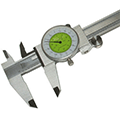
Calipers are used to measure a range of dimensions, such as:
1. Length
2. Width
3. Depth
4. Diameter
Micrometers are designed for higher-precision measurements, typically of thickness or diameter over a smaller range.
What is a moisture meter used for?
A moisture meter measures the moisture, humidity, or temperature of a material, helping identify conditions that could affect quality, safety, or performance.
What brands of precision measuring tools does Penn Tool Co. carry?
Penn Tool Co. carries precision measuring tools from established manufacturers, including Mitutoyo, SPI Swiss Precision Instruments, Starrett, Insize, Precise, and much more.