Metalworking Coolants Explained: Types, Selection & Maintenance for CNC Shops
Metalworking Coolants Explained: Types, Selection & Maintenance for CNC Shops

High-performance machining isn't just about the horsepower of your spindle or the precision of your ball screws. Everything hinges on the split-second thermal exchange between the carbide and the workpiece. At the exact point where a carbide insert meets a block of 6061 aluminum, temperatures can spike instantly, threatening to weld the chip to the tool and ruin a finish in seconds. This is where metalworking coolants step in: not just as a "nice to have," but as the foundational chemistry that makes modern, high-speed production possible.
Choosing the right cutting fluids for your shop floor is a complex calculation involving metallurgy, chemistry, and biology. Get it right, and you’ll see tool life skyrocket and surface finishes that look like mirrors. Get it wrong, and you’re looking at fried end mills, rusted parts, and a shop that smells like a swamp. In this guide, we’ll dive into the world of machining coolant, exploring how to select, manage, and maintain your fluids to ensure your operation stays profitable and precise.
The Triple-Threat Duty of CNC Coolant
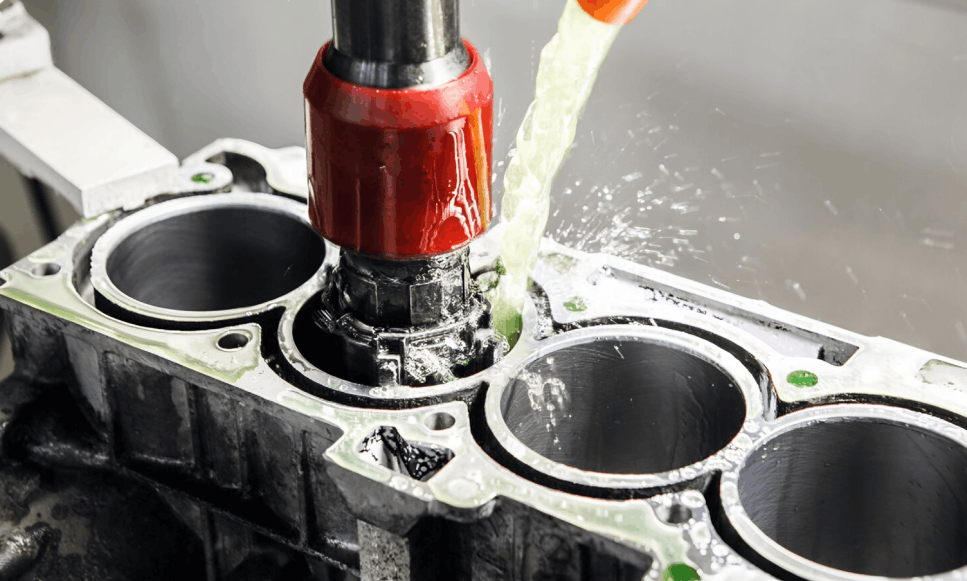
To the untrained eye, CNC coolant might look like simple colored water. In reality, it is a sophisticated chemical cocktail designed to perform three critical, simultaneous functions:
- Heat Dissipation: Metalworking is a friction-heavy process. Coolant acts as a heat sink, whisking thermal energy away from the tool and the workpiece to prevent warping and catastrophic tool failure.
- Lubrication: Beyond just cooling, the fluid provides a boundary layer that reduces friction. This is essential for preventing "Built-Up Edge" (BUE), where material sticks to the cutting edge and degrades the surface finish.
- Chip Management: High-pressure coolant systems physically blast chips out of the cutting zone. If chips aren't cleared, the tool "re-cuts" them, which leads to rapid wear and erratic part dimensions.
At Penn Tool Co., we’ve learned that the most successful shops treat their coolant as an asset to be managed, not just a consumable to be bought.
Decoding the Coolant Spectrum: Types and Applications
There is no "universal" fluid. Your choice depends on whether you value lubrication or cooling more for your specific workflow.
1. Straight Oils (Non-Emulsifiable)
Straight oils are used exactly as they come out of the drum. They offer the highest level of lubricity but are poor at carrying away heat.
- Best for: Slow-speed, heavy-duty operations like broaching, deep-hole drilling, or gear hobbing where friction reduction is the top priority.
2. Soluble Oils (Emulsions)
These are the traditional "milky" fluids. They consist of oil droplets suspended in water using emulsifiers.
- Best for: General-purpose machining where you need a healthy mix of cooling and lubrication.
3. Synthetic Fluids
Synthetic machining coolant contains zero petroleum oil. Instead, it uses chemical polymers and inorganic salts to provide cooling.
- Best for: Grinding operations. They provide excellent cooling, don't foam under high pressure, and offer the best visibility (they are usually clear).
4. Semi-Synthetic Fluids
The current industry favorite. These contain a small percentage of oil (usually 5% to 30%) mixed with synthetic components.
- Best for: Versatile job shops. They provide the cooling of a synthetic with enough "oiliness" to handle most milling and turning tasks in aluminum, steel, and stainless.
The Professional Selection Process
Choosing a metalworking coolant isn't a "one and done" decision. You need to evaluate three environmental variables to ensure compatibility.
Variable A: Material Compatibility
The chemistry of your fluid must play nice with your metal. For example, some active sulfur additives found in heavy-duty oils will stain copper or brass. Similarly, high-pH coolants can cause "white rust" or staining on sensitive aluminum alloys used in aerospace. Always match the fluid's chemical profile to your most common workpiece material.
Variable B: Shop Water Quality
This is the most overlooked factor in North America. Since coolants are mostly water, the minerals in your tap (calcium and magnesium) can cause "hard water soap" to form. This clogs filters and causes the emulsion to split. Conversely, "soft" water can cause coolants to foam excessively. Testing your water before buying a concentrate is essential.
Variable C: Pressure and Delivery
Are you running high-pressure through-spindle coolant (TSC)? If so, you need a "low-foam" formula. Traditional coolants can turn into a bubble bath under 1,000 PSI, triggering machine alarms and starving the tool of actual fluid.
Leading Metalworking Fluids & Equipment at Penn Tool Co.
To help you navigate the inventory at Penn Tool Co., here is a breakdown of industry-standard solutions categorized by their specific application and the specialized equipment needed to maintain them.
|
Category |
Recommended Brand/Series |
Primary Applications |
Key Features |
|
Soluble Oil |
Rustlick WS-500N |
General purpose milling & turning |
Non-chlorinated; great for diverse materials. |
|
Semi-Synthetic |
Rustlick Vytron-N |
Heavy-duty CNC machining |
Excellent cooling with added lubricity for tool life. |
|
Synthetic |
Rustlick G-25J |
Precision grinding operations |
High transparency; leaves no tacky residue. |
|
MQL/Mist |
Trico MD-1200 / Accu-Lube |
Minimum Quantity Lubrication |
Near-dry machining; reduces environmental waste. |
|
Refractometers |
Precise / Atago |
Coolant concentration testing |
Ensures the 5-10% "Sweet Spot" is maintained. |
|
Tramp Oil Removal |
Abanaki Skimmers |
Coolant sump maintenance |
Removes surface oils to prevent bacterial growth. |
Conclusion: A Clean Machine is a Productive Machine
At the end of the day, metalworking coolants are the lifeblood of your manufacturing process. By selecting the right chemistry for your materials and committing to a rigorous coolant care routine, you protect your tools, your machines, and your staff.
Don’t let poor fluid management be the bottleneck in your production. Invest in the right testing tools and high-quality fluids today. Whether you need a high-performance semi-synthetic for an aerospace contract or the maintenance tools to keep your current sump fresh, Penn Tool Co. provides the precision equipment that can upgrade your shop's fluid management. Explore our full range of CNC coolant accessories and maintenance tools at Penn Tool Co.
Frequently Asked Questions (FAQ)
1. Why does my metalworking coolant smell like rotten eggs?
That "Monday morning smell" is caused by anaerobic bacteria. When tramp oil (way oil) floats on top of your machining coolant, it blocks oxygen. Bacteria thrive in this environment, eating the coolant additives and releasing hydrogen sulfide gas. Regular skimming and aeration can prevent this.
2. Can I use the same coolant for both aluminum and stainless steel?
Yes, most high-quality semi-synthetic cutting fluids are "multi-metal" compatible. However, you must ensure the coolant has "extreme pressure" (EP) additives for the stainless steel and is "non-staining" for the aluminum. Always check the manufacturer's technical data sheet (TDS).
3. What happens if my CNC coolant concentration is too high?
While you won't get rust, a concentration that is too high (e.g., 15%+) is a waste of money and can cause "foaming" in high-pressure systems. More importantly, it can lead to skin irritation for operators and leave a sticky residue on your parts and machine.
4. How often should I check my coolant concentration?
In a professional B2B environment, you should check your coolant systems daily with a refractometer. Water evaporates every day, which causes the concentration to rise. Adding a "make-up" solution of a very lean mix (1–2%) helps maintain the target balance.
5. What is the difference between "synthetic" and "semi-synthetic" coolant?
Synthetic coolants contain no oil and offer superior cooling and visibility, making them great for grinding. Semi-synthetics contain a small amount of oil, providing the lubrication necessary for heavier cutting and tapping operations while still offering excellent cooling properties.